The Virgin Mary is one of the characters who give the Verges Procession its emotional continuity. Her encounter with Jesus and the conclusion at the foot of the cross tell the Passion through a mother’s eyes. This theatrical role also has a history of women’s participation and of passing the part from one actress to another.
The mother of Jesus in the script
In the 2011 edition of the text, Mary shares the encounter scene with Maria Salomé and Maria Jacobé. The two women try to comfort her as she expresses the pain of seeing her son led to his death. To explain this group, we need to follow the characters in the Verges script, rather than automatically applying other classifications of the Three Marys.
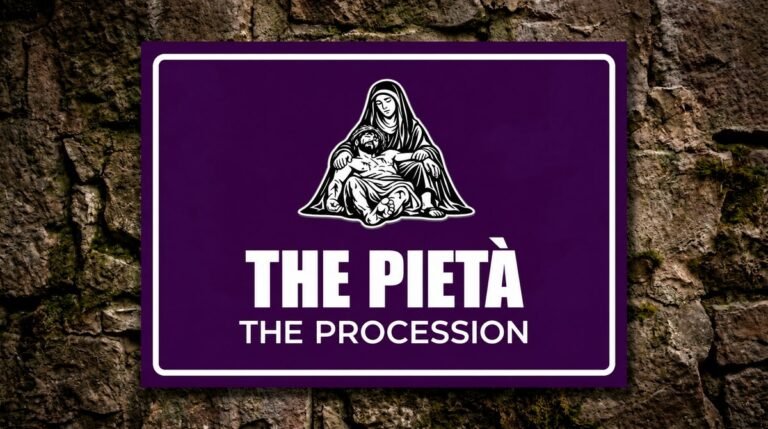
Mary appears later in the Crucifixion, and her role culminates in the Descent from the Cross and the Pietà, when she receives Jesus in her lap. The final lament is also a specific contribution attributed to Maria Perpinyà by the 2011 study: the renewal of the texts included both adaptations and original passages.
The actresses and changes in casting
Mercè Roviras Bofill recalls Carles Perpinyà asking her to play the Virgin when she was older, at a time when it was difficult to find women for these parts. The director would find the other two performers. This account describes a particular casting situation, not a permanent shortage.
Maite Poch Roviras remembers changes in the actresses’ ages: in some periods, major parts went to very young women; later, older women returned for the presence they brought to the character. Her recollection shows that casting choices have changed, without establishing one rule for every edition.
A mother and son beyond the stage
Maite played the Virgin Mary while her son, Ignasi Sabater Poch, played Jesus. She particularly recalls the emotion of holding him in her arms in the final tableau. Their family relationship brought a personal experience to the role, but we cannot present this as the only such case without a complete record of casts.
The character and the statue of the Dolorosa
The actress playing Mary and the statue of the Dolorosa, Our Lady of Sorrows, are distinct presences in the Procession. Mercè also remembers carrying this statue with other young women. Someone’s involvement could include different forms of participation, without the theatrical character and the processional statue being the same element.
Sources
La Processó de Verges, 2011 edition, study of Maria Perpinyà and scenes of the encounter and the Descent from the Cross. Interviews with Mercè Roviras Bofill and Maite Poch Roviras in the Memòria Viva La Processó project, analysed as part of this research.