Every Maundy Thursday, the Verges Passion Play brings the town square to life. This grand performance, a highlight of Holy Week in Empordà, transforms the town center of Verges into a stunning open-air theatre against the backdrop of the medieval walls. Check the official programme for each edition for the schedule and admission arrangements.
This performance in the Square is more than a simple play; it is the central act that gives meaning to and kicks off the historic Procession. It combines traditional 18th-century texts with a contemporary staging that will give you goosebumps.
The Verges Passion Play: A Unique Staging
What makes the performance in the Square so special is its atmosphere. In 2009, the artistic direction took a significant leap forward under the guidance of Lluís Llach, who adapted and modernised the show while respecting its traditional essence.
- Lighting: Light plays a key narrative role. You will journey from the festive, colourful brightness of the entry into Jerusalem to the dramatic gloom of the final judgement, passing through the fire of the Roman torches.
- The Soundtrack: In the Square, music underscores the drama. Highlights include sacred pieces like the Agnus Dei and symphonic fragments by Shostakovich, which add an almost cinematic tension during the Sanhedrin’s plot or Pilate’s trial.
- The Acoustics: The dialogues, written in rhyming and understandable verse thanks to the adaptation by siblings Carles and Maria Perpinyà, resonate against the old stone of the wall, creating a unique atmosphere that envelops the audience.
How the performance in the Square took shape
The performance that now defines this space is the result of successive transformations. Before the reorganisation of the 1950s, scenes were distributed around different parts of Verges. The village was also the theatrical space: the action moved with the Procession, and participants had to adapt to each location.
The Square, however, already had an earlier theatrical role. According to Jordi Roca’s study published in 2011, a platform had been used there for the Pilate scene since 1920. The later reform should therefore be understood as bringing scenes together and reorganising them, rather than as the first theatrical use of this space.
Carles and Maria Perpinyà: stage and words
Carles Perpinyà played a central part in this reorganisation. Màriam Serrà dates his appointment as director to 1950 and the Patronat’s approval of the change to 1955. Bringing the performance together in the Square allowed the first part to be followed with greater dramatic continuity; the Procession then continued through the streets.
Charging admission in the Square helped finance the event, while the route through the streets remained open to the public. The theatrical organisation and financial needs were part of the same change.
The work on staging was accompanied by the literary contribution of Maria Perpinyà. She adapted verses, selected passages by other authors and wrote new ones. The 2011 edition traces some of these contributions and reminds us that the Procession’s text has a history of its own, shaped by different hands.
The actors’ work and later renewals
Oral memory explains the dedication behind the performance. Mercè Rovira i Bofill remembers Carles’s instructions about voice, gesture and expression. Josep Maria Llach i Grande recalls scenes distributed around the village and the transformation involved in bringing them together. These accounts help us see the stage as a place of shared work, beyond the moment when the audience arrives.
The renewal led by Lluís Llach between 2009 and 2011 opened another chapter. The 2011 book also records textual modifications prepared between 2008 and 2011 and explains the work of revising language, verse and the order of certain scenes. The tradition performed in the Square has thus incorporated changes in direction, interpretation and writing over time.
These dates explain the history of the performance. For the schedule and admission arrangements of each edition, consult the official Procession programme.
To explore this history further, see the versions and authorship of the Procession texts.
Sources for the expanded account
Jordi Roca, introductory study in La processó de Verges. Text de l’obra (Diputació de Girona, 2011), pp. 8–13 and 23–31; note on adaptations. Màriam Serrà, Verges i la processó que no es veu (El Mèdol, 1998), pp. 46–47. Documents from interviews with Mercè Rovira i Bofill and Josep Maria Llach i Grande.
The Scenes: What You’ll See in the Verges Square Performance
The performance lasts about two hours and narrates the events chronologically. These are the main scenes you will experience from your seat:
1. Palm Sunday (Triumphal Entry into Jerusalem)
It’s the beginning, full of light and colour. Jesus enters riding a donkey, acclaimed by the entire town and especially by the children of Verges, who wave olive and laurel branches while singing ‘Hosanna’. It’s the only moment of collective joy before the tragedy.
[ READ MORE ]
2. The Samaritan Woman
The action becomes more intimate. Jesus meets the Samaritan woman at Jacob’s well. It is a scene of intense dialogue about conversion and living water, breaking the cultural barriers of the time.
[ READ MORE ]
3. The Last Supper
On stage, Jesus and the twelve apostles celebrate the last supper. Here, the Eucharist is instituted, and in a dramatic turn, the imminent betrayal by Judas is announced, all under warm, intimate lighting.
[ READ MORE ]
4. The Sanhedrin
Politics comes into play. The high priests, led by Caiaphas, conspire in the darkness to arrest Jesus. It is here that the deal with Judas for the 30 pieces of silver is sealed, marked by solemn and menacing music.
[ READ MORE ]
5. Appearance of the Dance of Death
Just after the conspiracy, and as a premonition of what is to come, the five skeletons of the Dance of Death make a brief but impactful appearance in the square, crossing the stage to the rhythmic sound of the drum.
6. The Garden of Gethsemane
The darkest and most tense scene. It combines the agony of Jesus praying in solitude with the violent arrival of the Roman soldiers (Manages), guided by torches, and Judas’s kiss. The arrest marks the point of no return.
[ READ MORE ]
7. Pilate’s Sentence
The final climax. The square is transformed into a Roman palace. Pontius Pilate, pressured by the people and the priests, washes his hands and condemns Jesus to the cross. With this powerful speech, the play ends, and the Procession through the streets officially begins.
[ READ MORE ]
Tips for Attending the Performance in the Square
Attending the performance in the Square is an experience that requires some planning:
- Tickets: They are limited and highly sought after. They go on sale online weeks in advance and usually sell out quickly. It is essential to buy them in advance through the official channels.
- The Weather: This is an open-air event in the Empordà region. Even in spring, nights can be cold, especially if the tramuntana wind is blowing. Bringing warm clothing is more than recommended; it’s essential to enjoy the play without shivering.
- Access: Allow enough time to find parking and enter the Square before the time stated in the official programme and on your ticket.
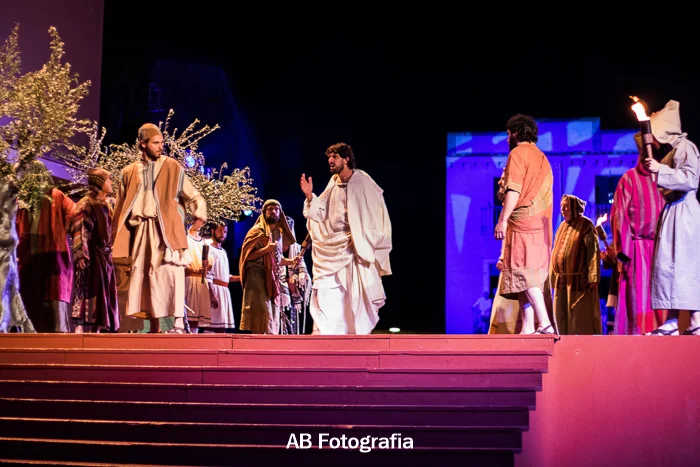
Photo: Albert Barnosell | Instagram