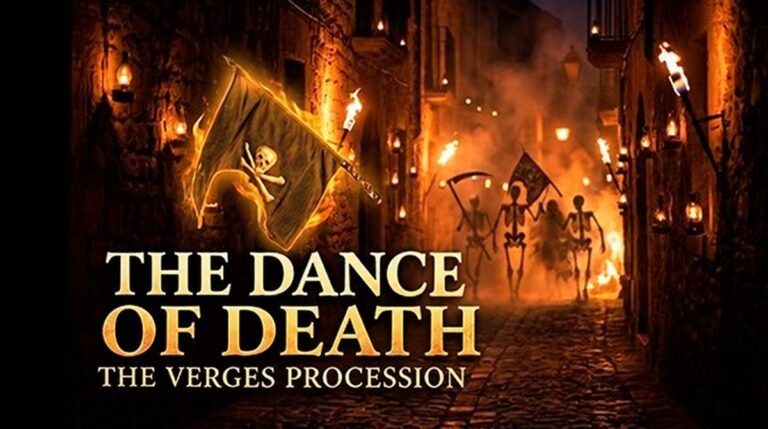
The Standard-Bearer, also known as la Bandera, stands at the centre of the five dancing skeletons. Behind la Dalla, he carries the Dance of Death’s messages and provides a reference point for the formation. His solemn appearance comes with a precise choreographic responsibility.
One flag, two messages
The black flag displays a skull and crossed bones. Its two sides combine Nemini parco (“I spare no one”) and Lo temps és breu (“Time is short”). The first recalls the universality of death; the second, the brevity of life. The Clock adds the uncertainty of the final hour.
A prop that has changed
Serrà describes an earlier flag with two skulls and a redesign linked to the 1955 trip: one skull with crossed bones and a different message on each side. Continuity of symbolism does not mean that every flag has been identical or that the same physical object has always been used.
At the centre of the choreography
In the 1996 account, la Bandera alternates his sideways orientation, facing each of the Platets in turn. This lets him check the children’s positions, spacing and the ground. The Clock stays aligned with la Bandera and la Dalla.
The five dancers form a cross adapted to the available space, with la Bandera at its centre and the Platets at either side. The skeleton suit and skull-shaped helmet make him part of the visual whole.

Sources and context
Màriam Serrà, Verges i la processó que no es veu (1998), pp. 121–123; 130–132; account of the Procession observed in 1996.