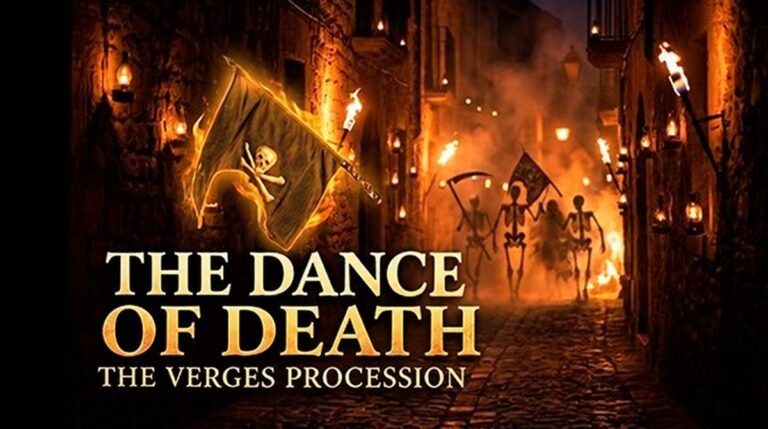
The Capdanser, known as la Dalla, leads the five dancing skeletons in the Dance of Death. The Tabal sets the rhythm and works with him to coordinate their progress. The scythe and dance evoke death reaping lives regardless of age or status.
The scythe and “Nemini parco”
Serrà describes a life-size wooden reproduction of a harvesting tool bearing the Latin inscription Nemini parco: “I spare no one.” This universal message belongs to the tradition of dances of death; it does not prove that the prop or choreography has remained unchanged since medieval times.
A full turn while moving backwards
La Dalla is the only dancer to make a full turn in his movement sequence. In the 1996 account, he advances backwards, facing the other skeletons. He must adapt the scythe’s movement to the street’s width and keep his distance from the preceding group.
The skull-shaped helmet restricts visibility. This role requires spatial awareness, stamina and coordination: precise dancing also means adapting to the space. Serrà describes the situation in 1996; this does not establish present-day age or selection rules.
Costume and position
The black suit with painted bones and skull-shaped helmet link him to the other dancers. Behind him stands la Bandera, the formation’s central reference point. In Snail Street, the group passes through the light of the tiny wall lamps.

Sources and context
Màriam Serrà, Verges i la processó que no es veu (1998), pp. 121–122; 128–130; account of the Procession observed in 1996.