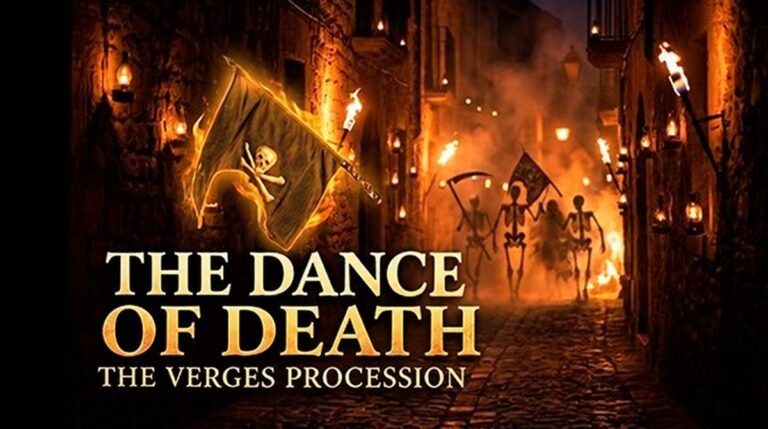
The Clock closes the group of five dancing skeletons, behind la Bandera. He carries a handless dial and points to different hours. His message is uncertainty: nobody knows the hour of death. The Tabal follows behind, accompanied by the figures lighting the Dance.
A dial without hands
Serrà describes a dial with hours painted on a square support. The dancer’s free hand acts as a clock hand when pointing to an hour. Prop and gesture express uncertainty: any hour may be the last. The skeleton suit and skull-shaped helmet connect this character to the other dancers.
The gesture within the dance
In the 1996 account, the Clock stays aligned with la Dalla and la Bandera and moves sideways in coordination with the group’s centre. When the dial faces outwards towards the Tabal, the child points to an hour; when it faces la Bandera, he rests his free hand on his waist. The gesture belongs to the dance’s alternating sequence.
This coordination keeps the Clock at the rear of the dancers’ cross. The Platets, on either side of la Bandera, complete its transverse axis. The formation adapts to the available space along the streets.
The Clock’s place in the ending
Being the last of the five dancers does not make him the last member of the procession or establish an individual order of bows. Serrà describes the church ending in her 1996 account. This must be distinguished from the outdoor bow in the 2011 script, a development explained in the Surrender of Death.

Sources and context
Màriam Serrà, Verges i la processó que no es veu (1998), pp. 122; 131–132; 134–137; account of the Procession observed in 1996.