Joaquim Ferrer i Amer (Verges, 1921–1996), known in the village as Quim Gil, was an instrumentalist, conductor, composer, arranger and music teacher. Born into a family closely connected with the musical tradition of Verges, his career took him from the Cobla Emporitana of Verges to the direction of La Principal de Girona, as well as to several musical ensembles in Catalonia and abroad. In Verges, however, his legacy went far beyond his professional career: he was deeply involved in the Procession and arranged the music of the Stabat Mater in the late 1950s. He was also the first piano teacher of Lluís Llach.
If you asked for Joaquim Ferrer in Verges, the name might not have been familiar to everyone. If you asked for Quim Gil, however, things were different. This was the name by which one of the most notable musicians to come from Verges in the 20th century was known throughout the village.
A family of musicians from Verges
Joaquim Ferrer i Amer was born in Verges in 1921 into a family in which music played an important role on both the Ferrer and Amer sides.
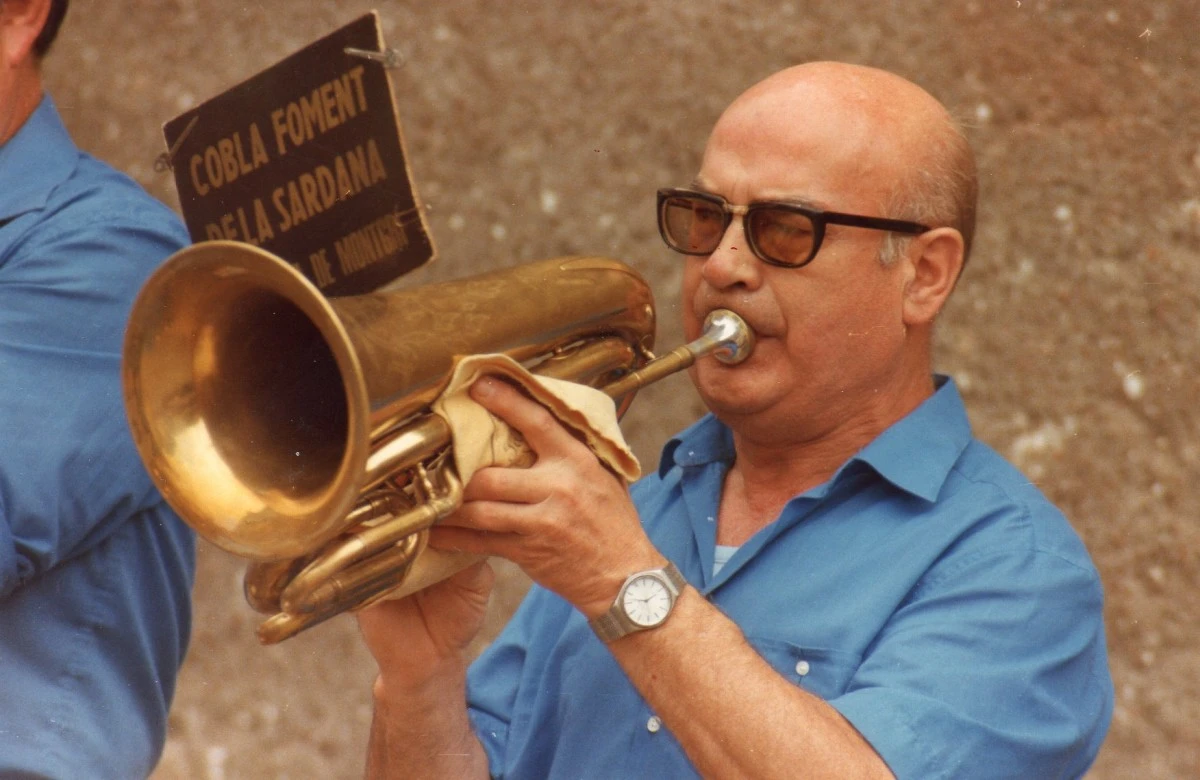
The family had close ties with the Cobla Emporitana of Verges. His father, Josep “Pepet” Ferrer, played the tenora; his uncle Manel Amer played double bass; his brother Manel “Manelic” Ferrer played the fiscorn; and Joaquim himself would also go on to play the fiscorn, a traditional brass instrument closely associated with the Catalan cobla. This musical family tradition is documented in a biography of Joaquim Ferrer published in 1980.
This family environment helps explain a musical path that began at an early age and eventually became his profession. Ferrer studied with teachers including Joaquim Vallespí and Francesc Civil i Castellví. Other accounts of his musical training also mention Miquel Cristòfol and Josep Cantó.
Over the years, he mastered several instruments. He was a pianist and organist, but also a trombonist and, in particular, a fiscorn player, an instrument on which he became known for his musicianship. Alongside his work as a performer, he also developed a career as a conductor, composer, arranger and teacher.
From the Cobla Emporitana to La Principal de Girona
The early years of Quim Gil’s musical career were closely connected with the Cobla Emporitana, one of the ensembles that reflects the rich musical tradition that existed in Verges throughout much of the 20th century.
Ferrer was not only a performer in the ensemble; over time, he also became its conductor. He played the fiscorn for sardanas and the piano for dances, a combination that illustrates his versatility as a musician.
A major step in his professional career came in 1957, when he became artistic director of La Principal de Girona, succeeding the musician Manuel Saderra i Puigferrer. At the time, it was an important ensemble in the world of cobla and dance orchestras, and Ferrer remained with it until 1965.
During this period, his role was not limited to conducting. He also performed on several instruments, including the trombone, and some of his sardanas were recorded under his direction.
A long professional career
After leaving La Principal de Girona, Joaquim Ferrer continued his career with several different ensembles. He conducted the Copacabana group for two seasons and later spent several years abroad, particularly in France and Switzerland, where he worked as an organist with different musical groups.
After returning to Catalonia, he continued to work professionally as a musician. He performed with several ensembles and, during the 1970s, joined the Cobla Baix Empordà. In the later stage of his career, he was also a member of the Foment de la Sardana de Torroella de Montgrí.
His career, therefore, cannot be reduced to a single instrument or ensemble. For decades, Quim Gil worked as a highly versatile musician, moving between the cobla and the orchestra, the piano and the organ, the fiscorn and the trombone, while also conducting, teaching, composing and arranging music.
Quim Gil and the Verges Procession
Despite his professional career outside Verges, Joaquim Ferrer maintained a strong connection with his home town. One of the areas where his influence can still be seen most clearly is the Verges Procession, which takes place through the streets of the village every Maundy Thursday.
Local memory recalls him taking part in different roles in the Procession over the years: first as an Apostle, later as a Manage — one of the Roman soldiers of the Verges Procession — in the post-war period, and eventually as a musician, playing the fiscorn in the ensemble associated with Veronica and the Stabat Mater.
His most important contribution, however, was not simply performing this music. Joaquim Ferrer played a direct role in the musical form of the Stabat Mater that became established from the late 1950s onwards.
The arrangement of the Stabat Mater
The Stabat Mater of the Verges Procession preserves an old melody that was originally sung by two male voices. In the late 1950s, Joaquim Ferrer created an arrangement that preserved the original melodic line.
This intervention is documented in the official catalogue report on the Verges Procession produced by the Department of Culture of the Government of Catalonia. The document explains that the old melody was arranged by Joaquim Ferrer in the late 1950s and, at the time of the 2010 catalogue report, was performed by a mixed choir accompanied by two transverse flutes and a fiscorn.
Through this arrangement, a traditional piece of music from the Procession acquired a new dimension without losing the melody on which it was based.
This contribution makes Quim Gil an especially important figure in understanding the musical history of the Verges Procession. His work did not replace the earlier tradition; instead, he worked with an existing melody and helped ensure its continuity.
A teacher for the Procession’s singers
Quim Gil’s contribution to the Procession extends beyond a written arrangement. Mercè Roviras Bofill, who sang in the choir and the Stabat, remembers him teaching the singers and singing with them. Her account places musical transmission in a shared practice: listening, rehearsing and learning with a musician from the village.
Màriam Serrà also describes this aspect on pp. 47–48 of Verges i la processó que no es veu (1998). She explains that Quim Gil had played an Apostle and a manage before taking part as a musician, and describes adding singing to the instrumental melody and subsequent arrangements. She mentions two flutes and a fiscorn, and a group of around fifteen to twenty singers in the period she documents.
This account and the 2010 catalogue report help distinguish the old melody, the arrangement and the direction of singing. They recognise Quim Gil’s contribution without making him the author of all the Procession’s historical music, or permanently fixing the number of voices and instruments.
Sources for this addition: Màriam Serrà (1998), pp. 47–48; catalogue report (2010); interview with Mercè Roviras Bofill in the Memòria Viva La Processó project, analysed as part of this research.
Lluís Llach’s first piano teacher
Teaching was another important part of Joaquim Ferrer’s musical life. Among his pupils was a young boy from Verges who would later become one of the best-known Catalan musicians of the 20th century: Lluís Llach.
The connection between Quim Gil and Llach is not merely a story passed down through local memory. Lluís Llach himself has publicly recalled that Quim Gil was his first piano teacher and that it was from him that he learned the technique of playing the instrument.
In an interview with Lluís Llach, the singer-songwriter recalled that he began studying with Quim Gil when he was approximately four years old and continued with him until he was seven or eight. He later continued his musical education with Montserrat Puigdemont, whom Llach has particularly credited with teaching him to love music.
The distinction Llach himself has made over the years is significant: Quim Gil gave him the technical foundations of piano playing, while Montserrat Puigdemont helped him develop a more emotional relationship with music.
This is an important detail not only in Ferrer’s biography but also in the musical history of Verges. Before Lluís Llach became a singer-songwriter, composer and one of the most recognised figures in Catalan music, his first steps at the piano were guided by another musician from Verges.
Quim Gil’s piano, preserved in Verges
This story also has a tangible link to the present. Joaquim Ferrer’s piano, the instrument on which Lluís Llach took his first steps as a pianist, was donated to the village of Verges by Anna Ferrer, the musician’s niece.
Verges Town Council announced the donation on 22 October 2020 and stated that the piano could be seen at the Visitor Centre. The announcement documents that moment; it does not date the start of the display to 2025.
Composer of sardanas
Joaquim Ferrer also left behind compositions of his own. His work as a composer focused particularly on the sardana and reveals another side of a musician who has often been remembered primarily as a performer, conductor or teacher.
Among the sardanas attributed to him are Capvespre, Desig, Afecte, L’avi de casa, L’aplec de l’Aliança and Reviu la il·lusió. Together with fiscorn player Enric Vilà, he also wrote Dansaires palamosins and Estimat amic, the latter conceived as an obbligato sardana for two fiscorns.
Some of these compositions date back to the 1940s. L’avi de casa and Desig, for example, date from 1942, while Afecte was dedicated to his parents.
Some of his music was also recorded. During Ferrer’s years with La Principal de Girona, several of his sardanas were recorded under his direction.
Verges pays tribute to Quim Gil
Over the years, part of Joaquim Ferrer’s work had become little known beyond musical circles and the collective memory of Verges. In 2017, the village launched an initiative to recover and celebrate his musical legacy.
Verges Town Council, with the collaboration of the Ferrer family, the Diputació de Girona and the Department of Culture of the Government of Catalonia, released an album featuring nine sardanas by Joaquim Ferrer, performed by La Principal de la Bisbal. According to the Town Council, these nine pieces represented the main body of his known work as a composer.
On 8 August 2017, Verges held a tribute to Joaquim Ferrer “Quim Gil”, including the presentation of the recording and a concert by La Principal de la Bisbal in La Placeta devoted to his compositions.
The event did more than bring Quim Gil’s music back to the public. It also highlighted the much broader musical tradition of Verges, built over generations by musicians and families connected with cobles, orchestras and other ensembles.
The legacy of Joaquim Ferrer i Amer
Joaquim Ferrer i Amer died in 1996. His influence, however, remains present in Verges in many different ways.
It lives on in the sardanas he composed and which, decades later, were performed again by La Principal de la Bisbal. It remains part of the history of the cobles and orchestras with which he performed. It can be found in the musicians who learned from him and, perhaps most famously, in the earliest musical education of Lluís Llach.
Above all, however, his legacy remains part of one of the most important traditions of his home town. Every Maundy Thursday, when the Stabat Mater is heard once again through the streets of Verges, part of the work Quim Gil carried out on that old melody in the late 1950s can still be heard.
Perhaps this is one of the best ways to understand his legacy. Joaquim Ferrer built a career beyond Verges, conducted musical ensembles, played several instruments, composed and taught music. Yet part of his work became woven into the musical memory of the village where he was born.
That is why, in Verges, Joaquim Ferrer i Amer remains, quite simply, Quim Gil.
You may also be interested in: Notable figures of Verges · Lluís Llach Grande · Maundy Thursday in Verges · The Verges Procession