Narcís Mir i Vilavella (1927–1992), known in Verges as Siset Mir, contributed to village life in many ways: the Procession, equipment, singing, cooking and local organisations. His work helps explain a tradition also sustained by people working away from centre stage.
A man involved in village life
Màriam Serrà explains that Siset had been a farmer but left that work for health reasons and became a trader. Her book portrays a cheerful, enterprising person involved in the village’s activities. It also records that he was deputy mayor in 1965 and a member of the Agricultural Chamber, the Irrigators’ Commission and the Procession’s Patronat.
Restoring, preparing and accompanying the Procession
According to Serrà, after the war he encouraged neighbours to recover damaged or stored costumes and equipment. This was a contribution to a collective revival, rather than sole responsibility for the entire return of the Procession or a precise date for every repair.
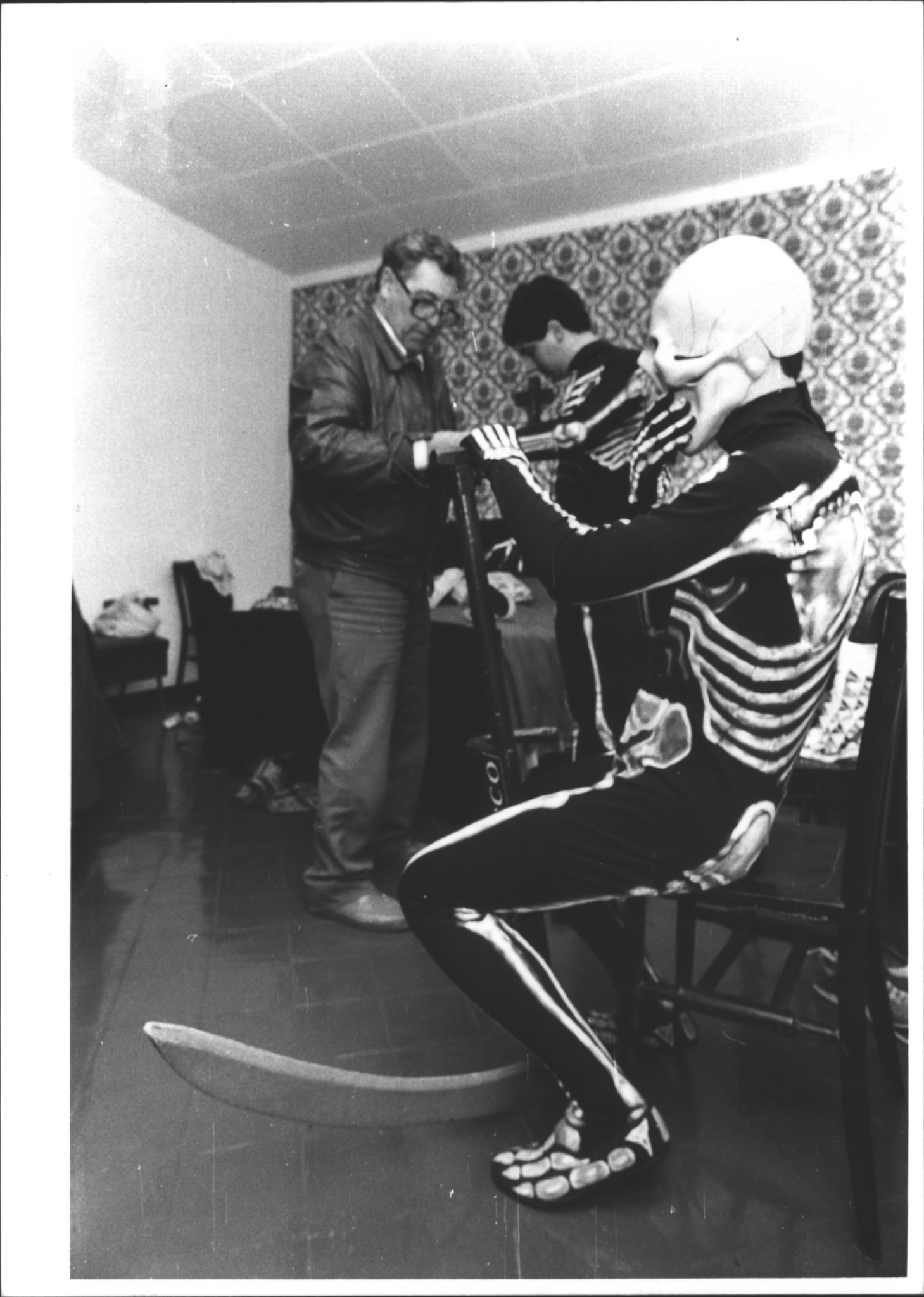
The same biography identifies him as a perxoner and attributes to him responsibilities relating to equipment and the smooth running of the Dance of Death. This role does not establish that he was one of the five dancers. The photograph preserved in this article, showing him helping dress the group, reveals another aspect of this supporting work.
Serrà also places him in the Coral Vergelitana. Choral participation, equipment duties and theatrical roles must be distinguished: we do not attribute forty-five years to the Stabat when the book associates that duration with cooking the Sopa.
The Sopa and the Easter Monday rice meal
The 1998 biography states that Siset was responsible for cooking the Sopa de Verges for forty-five years. It describes knowledge passed on by his predecessor and cooking by eye, without turning this retrospective figure into a complete annual chronology.
It also recalls his involvement in the Sopa Commission, established in 1981, and preparing the communal rice meal on Easter Monday. The Sopa and this gathering are separate celebrations; they should not be combined into a single Holy Week meal.
Posthumous recognition
Serrà dates his death to 1992 and explains that, the following Holy Week, the manages and the Dance offered a commemorative salute outside his home. According to the same book, the council proclaimed him Fill Predilecte, an honoured son of the village, on 18 December 1994, posthumously.
The repairs of 1976: an attribution awaiting confirmation
The Crònica d’uns vestits attributes the repairs that allowed cardboard breastplates to be reused in 1976 to Ciso Mir. The consulted material does not yet confirm that this name identifies Siset. We retain the chronicle’s attribution without adding it as a proven intervention in his biography. The wider story appears in Renewing the Verges Manages’ equipment, 1975–1977.
Sources
Màriam Serrà, Verges i la processó que no es veu (1998), p. 49. Llorenç Cansell and Jordi Roca, “Crònica d’uns vestits”, País Petit, July 2007, p. 33. These retrospective accounts do not replace annual records or the municipal record of the honour.