The Dance of Death of Verges is one of the best-known tableaux in the Verges Procession. The skeletons, the drum and the objects they carry turn movement into a reminder of life’s brevity. Its continuity also depends on participants’ work, rehearsals and the renewal of costumes and equipment.
Origins and history: what can we document?
Macabre dances belong to a European tradition with late-medieval antecedents. That wider history does not by itself establish the origins of the local dance or prove that its present form has remained unchanged since the Middle Ages.
The 2010 heritage assessment separates the two questions: the permission dated 1666 documents the Verges Procession, whereas for the Dance it reports that no material documentation of the Dance earlier than 1915 was known. This describes the documentary limit recorded in that report; it does not mean that the dance began in 1915.
The document brings together analyses of the iconography, cross formation, costumes and mottoes suggesting a configuration with Baroque features and a probable existence in the nineteenth century, without ruling out greater antiquity. These clues must be distinguished from a proven foundation date. The exceptional value of the Dance of Verges does not depend on claims of absolute uniqueness, but on its history, its configuration and the continuity of the tradition.
The tableau: five dancers and their companions
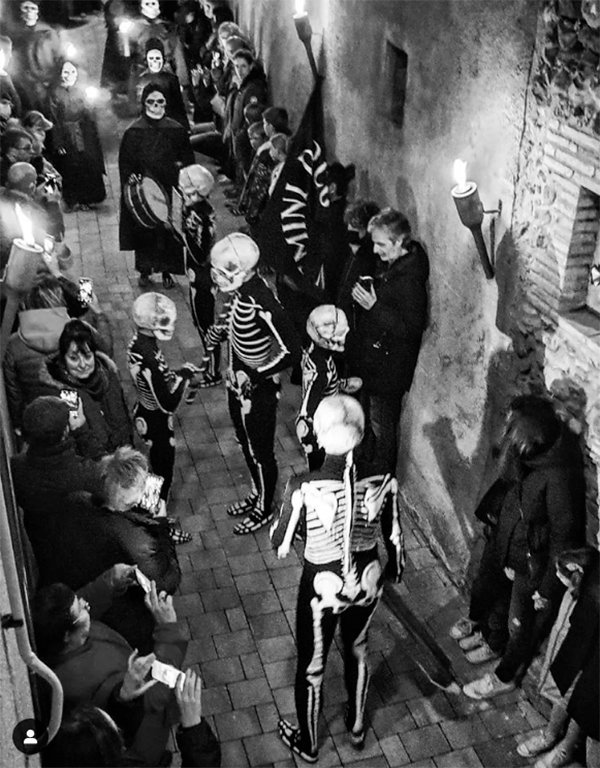
The core consists of five dancing skeletons arranged in a cross: the Scythe, the Banner, two Platets and the Clock. The Tabal and four torchbearers complete the tableau. The five dancers are therefore not its entire membership.
Jordi Roca describes the Scythe directing forward movement and the Banner providing a central reference for maintaining distances. The drummer coordinates with the capdanser and signals pauses and restarts. The movement seen by the audience results from this shared work, rather than the will of one dancer alone.
Characters and symbols
The Scythe or Capdanser
The Capdanser, or lead dancer, carries the scythe, an image of death reaping life. The Latin motto Nemini parco, “I spare no one”, reinforces that message. Roca describes the dancer moving backwards and making complete turns, allowing observation of the surroundings and control of the dance’s space.
The Banner
The Banner Bearer stands at the centre of the formation. The banner expresses life’s brevity through the motto Lo temps és breu, “time is short”. Its position also has a practical function: it is the reference point that helps preserve the cross formation.
The Platets
The two Platets, played by children in the descriptions consulted, carry small dishes of ash as a reminder of mortality. They occupy the cross’s side arms. The similarity of the roles does not establish that the performers must be twins; nor should ages described for one period become permanent selection rules.
The Clock
The Clock closes the axis of the five dancers. Its face without hands and the gesture of pointing to an hour express uncertainty about the moment of death. In Roca’s description, this gesture alternates with displaying the clock face to the audience.
The Tabal and the torches
The Tabal, or drum, supplies the rhythm and signals stops and restarts. The four torches illuminate the tableau. Roca describes these roles as members who walk, distinct from the five skeletons who dance. Together they combine movement, sound and light.
A tradition with renewed costumes and equipment
The history of costumes and skull masks shows both continuity and change. On pages 48–49 of the 1997 edition, Roca explains that before 1955 the group used two-piece costumes and cardboard skull masks. He identifies Ramon Marín, el Mut, as the craftsman who made and maintained the skull masks and the manages’ helmets.
The same author connects the renewal in 1955 with a visit to Madrid: new one-piece costumes were introduced and the skull masks replaced. He also describes changes to the drummer’s costume and the torchbearers’ adoption of that pattern.
Roca documents another renewal of the costumes in 1985, painted by Anna M. Poch, and the skull helmets in 1986. The pre-1955 costumes had passed to the Children’s Procession. These facts explain particular stages in the equipment’s history; they do not automatically identify the items used today or certify their condition.
The Street of Snails and the ending
The Street of Snails has a distinctive form of lighting made with shells, oil and wicks. Màriam Serrà describes the residents’ preparations in her account of 1996. Their work forms part of the visual setting through which the Procession moves and has its own history, explained in the article about the street.
The dance also makes a final gesture of reverence. The reverence inside the church, described by Serrà, must be distinguished from the outdoor theatrical homage prescribed by the 2011 script. These are different moments and accounts; we do not combine them into a present-day sequence without checking the relevant edition.
How to see the Dance of Death
The organisers’ official visitor guide, consulted on 6 October 2026, announces 25 March 2027 as the next Maundy Thursday. Its timetable lists 9.30 pm for the performance in the Plaça and 11.30 pm for the street Procession. The procession’s starting time does not establish when the Dance passes each location.
The Plaça performance requires a ticket; the street procession is free. The guide announces that ticket sales will open on 8 December 2026. Before planning a visit, check the official guide and the programme and ticket pages for times, availability and possible changes. The organisers ask visitors not to use flash photography.
Sources
Generalitat de Catalunya, Memòria de catalogació de la Processó de Verges, 6 September 2010, historical section and description of the Dance. The analyses of the scholars mentioned were consulted through this document.
Jordi Roca i Rovira, La Processó de Verges, second revised and expanded edition, 1997, pp. 34–44 and 48–49, for the roles, coordination and equipment renewals.
Màriam Serrà, Verges i la processó que no es veu (1998), pp. 86–87, 103 and 134–137; La Processó de Verges. Text de l’obra (2011), pp. 138–141, to distinguish historical accounts of the street and the endings. The Associació’s official guide supplies practical information for 2027.