The Surrender of Death expresses, in a Christian reading of the Procession, Death’s submission before redemption. The bow plays a prominent part in the ending, but the sources describe different stagings: the church ending observed in 1996 and the outdoor finale in the 2011 script.
The bow inside the church in 1996
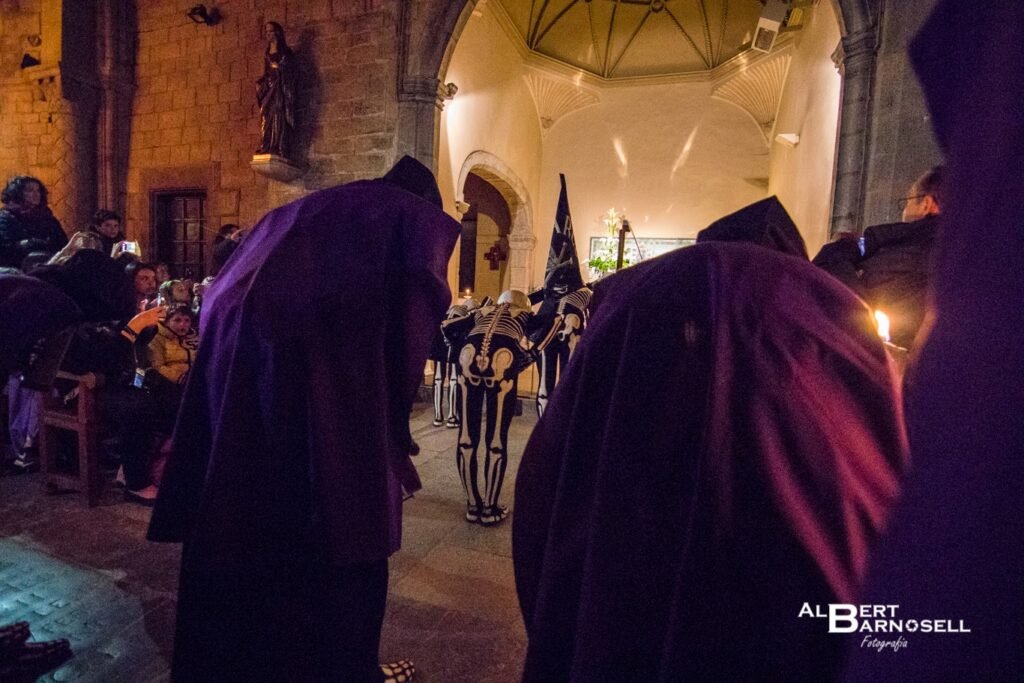
Màriam Serrà explains that the Procession she observed ended with two simultaneous scenes a few metres apart: the Crucifixion outside and the Dance of Death’s bow inside the church. Spectators had to choose between the two climactic acts; they were not consecutive endings that could both be watched in full.
In that account, the Dance entered along the central aisle, performed its final jumps and bowed before the tabernacle. Torches and candles lit the gesture. The book also describes restricting access because of limited space. These are details of that performance, not visiting instructions for the current edition.
The outdoor bow in the 2011 script
The script published in La Processó de Verges (2011), p. 141, places the bow at the end of the Calvary scene, after the Descent from the Cross and the formation of the Pietà. The Dance ascends from the foot of Calvary, bows and withdraws. This stage direction does not document a subsequent entry into the church.
The meaning of the gesture
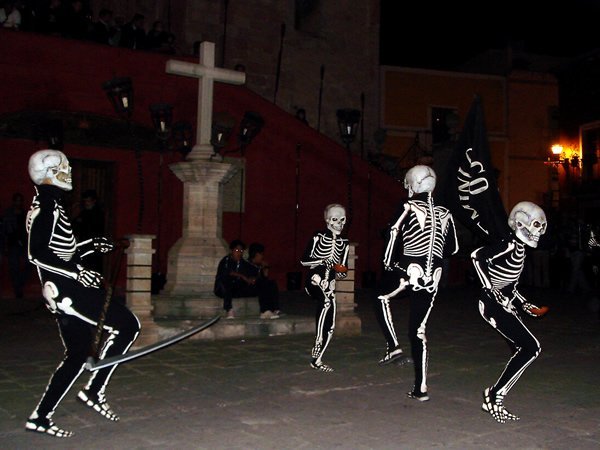
Death, which proclaims Nemini Parco through la Dalla and la Bandera, bows at the end of the story. In a Christian interpretation, the gesture expresses redemption’s triumph over death. This symbolism can be explained without attributing the same religious experience to every participant and spectator.
Sources and context
Màriam Serrà, Verges i la processó que no es veu (1998), pp. 134–137; account of the Procession observed in 1996.
Jordi Roca i Rovira, Lluís Llach, Dani Vivern and Lluís Muntada (editors), La Processó de Verges (2011), p. 141.