Veronica appears in the First Fall, in La Placeta, in the script published in 2011. Her gesture of wiping Jesus’s face introduces an act of compassion amid the tormentors’ attacks.
The Scene of the First Fall in The Little Square
In the 2011 stage directions, Jesus falls before Veronica while the theatrical Jewish characters and the Manages form circles around the action. He tries to resume his journey but falls again; she steps out of the crowd, approaches and delivers her speech.
Veronica addresses Jesus and asks to wipe his face; she also calls on the tormentors to show mercy.
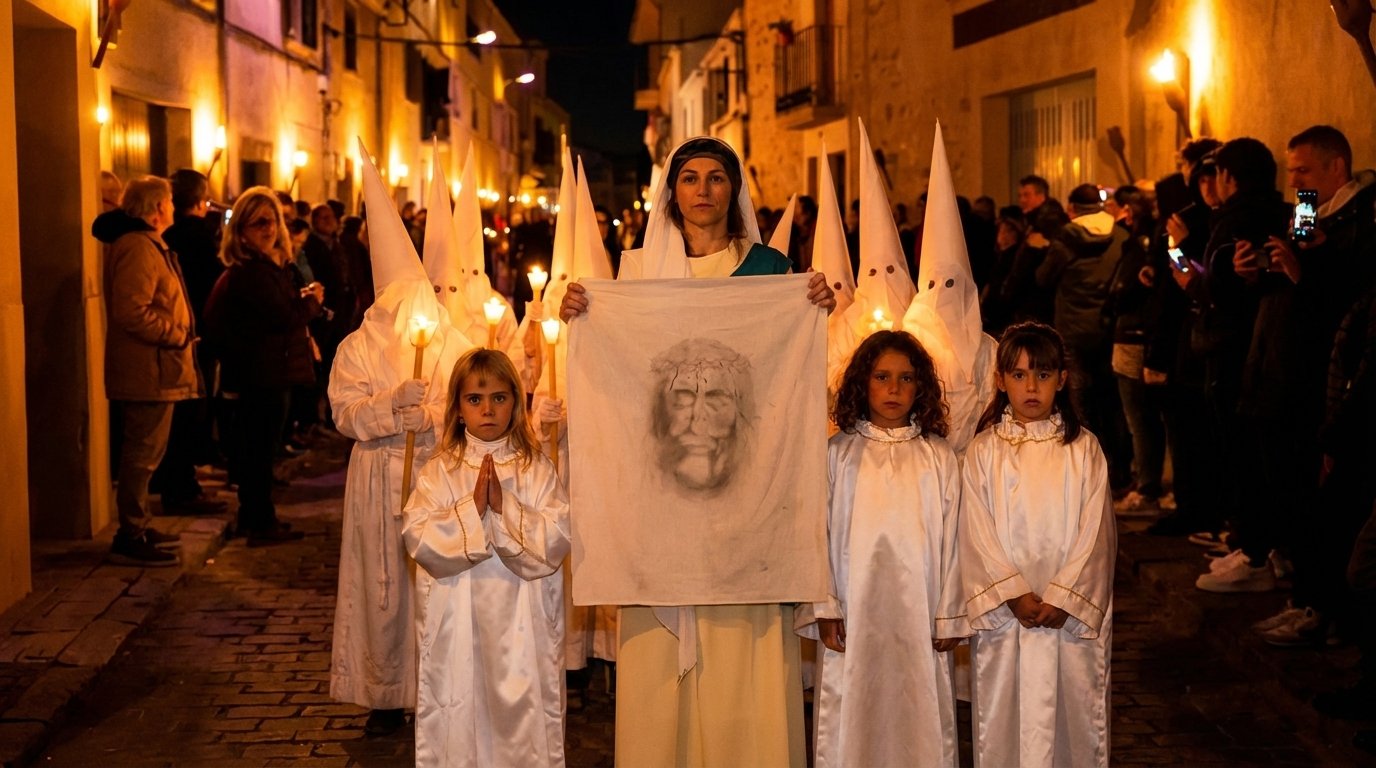
The Veil and the Miracle of the Face: “What a Prodigy!”
Veronica’s speech mentions a perfume of spikenard and rose. This is a detail of the dramatic text, not a verified instruction for preparing the cloth today. The stage directions say that she wipes Jesus’s face and discovers his image on the cloth as she removes it.
The stage directions describe her amazement on discovering the image on the cloth.
She exclaims in wonder at what the represented story presents as a miracle.
Veronica shows the image to the theatrical Jewish characters, who turn their backs. She then kneels and addresses Jesus to thank him for the miracle. Finally, she withdraws to join the procession at her turn. See also: The Jews.
Symbolism of the Veronica Verges Procession
In a Christian reading, the cloth may express recognition and gratitude in response to compassion. Veronica addresses Jesus to thank him for the image of his face, which her speech presents as a sign of his love.
Veronica’s gesture forms part of the visual narrative of the First Fall, combining her speech with an image that is particularly recognisable along the route. The scene belongs to the Procession on the night of Maundy Thursday.
History and transmission of the role
Màriam Serrà describes a change of actress during the Holy Wednesday rehearsals in 1996 (pp. 80–81). A young woman was taking on the role while her predecessor watched with emotion. The book does not identify either woman by name. This is a specific example of transmission and continuity, not a general rule for choosing Veronica’s interpreters.
Sources and versions
Màriam Serrà, Verges i la processó que no es veu (1998), pp. 80–81 (account of 1996); La processó de Verges. Text de l’obra (2011), pp. 107–109.