The Solemnity of the Sacred Heart of Jesus celebrates Christ’s human and divine love, symbolised by his heart. It falls on a Friday after Corpus Christi and moves each year because its date is calculated from Easter.
When is the Sacred Heart celebrated?
In the Roman Catholic calendar it is the Friday after the Second Sunday after Pentecost—nineteen days after Pentecost and sixty-eight days after Easter.
The annual solemnity is different from the First Friday devotion observed monthly by some Catholics. They belong to the same spiritual tradition but have different places in the calendar.
What does the heart mean?
In biblical language, the heart is the deep centre of the person: thought, will, desire and love. Catholic devotion does not worship an isolated organ. It honours Christ himself and the love expressed through his humanity.
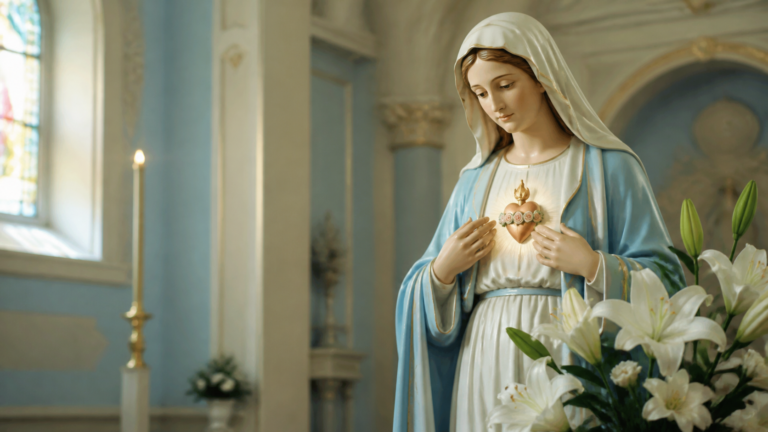
Images often show flames, a cross and a crown of thorns, representing love, Passion and self-giving. Pope Pius XII warned against reducing the devotion to external practice or sentimentality.
How did the devotion develop?
Reflection on Christ’s pierced side and love appears in ancient and medieval Christianity. Bonaventure, Gertrude the Great and other writers developed a spirituality of the heart before a universal feast existed.
The modern form grew especially in seventeenth-century France. John Eudes promoted a liturgical office, while Margaret Mary Alacoque at Paray-le-Monial reported mystical experiences focused on love and reparation. The Jesuit Claude de la Colombière helped spread the devotion.
After limited approvals, Pope Pius IX extended the feast to the universal Church in 1856. Pius XII explained its theology in Haurietis aquas in 1956. Pope Francis returned to the theme in the 2024 encyclical Dilexit nos.
What does reparation mean?
Reparation is a response to Christ’s love through conversion, prayer and action against the harm caused by sin. It is not a material payment offered to God. At its best, it joins spiritual renewal to mercy and responsibility towards other people.
First Fridays, Eucharistic adoration and personal or household consecration are associated practices. Private revelations may shape a devotion, but they do not replace the Gospel, the sacraments or Christian charity.
Different European settings
France is central through Paray-le-Monial and the later Basilica of Sacré-Cœur at Montmartre. Spain, Portugal, Italy, Poland and other Catholic countries developed churches, associations and public acts of consecration with their own historical settings.
The feast is specifically Roman Catholic in its present form. Anglican communities may use Sacred Heart language less often, while Orthodox and Protestant traditions do not generally share the same devotion. Europe should therefore not be described as having one common practice.
How it relates to Easter and Corpus Christi
The Passion reveals love given to the end; Easter celebrates victory over death; Pentecost the gift of the Spirit; and Corpus Christi the Eucharist. The Sacred Heart brings these themes together through the symbol of Christ’s love.