remembered writer Maria Perpinyà
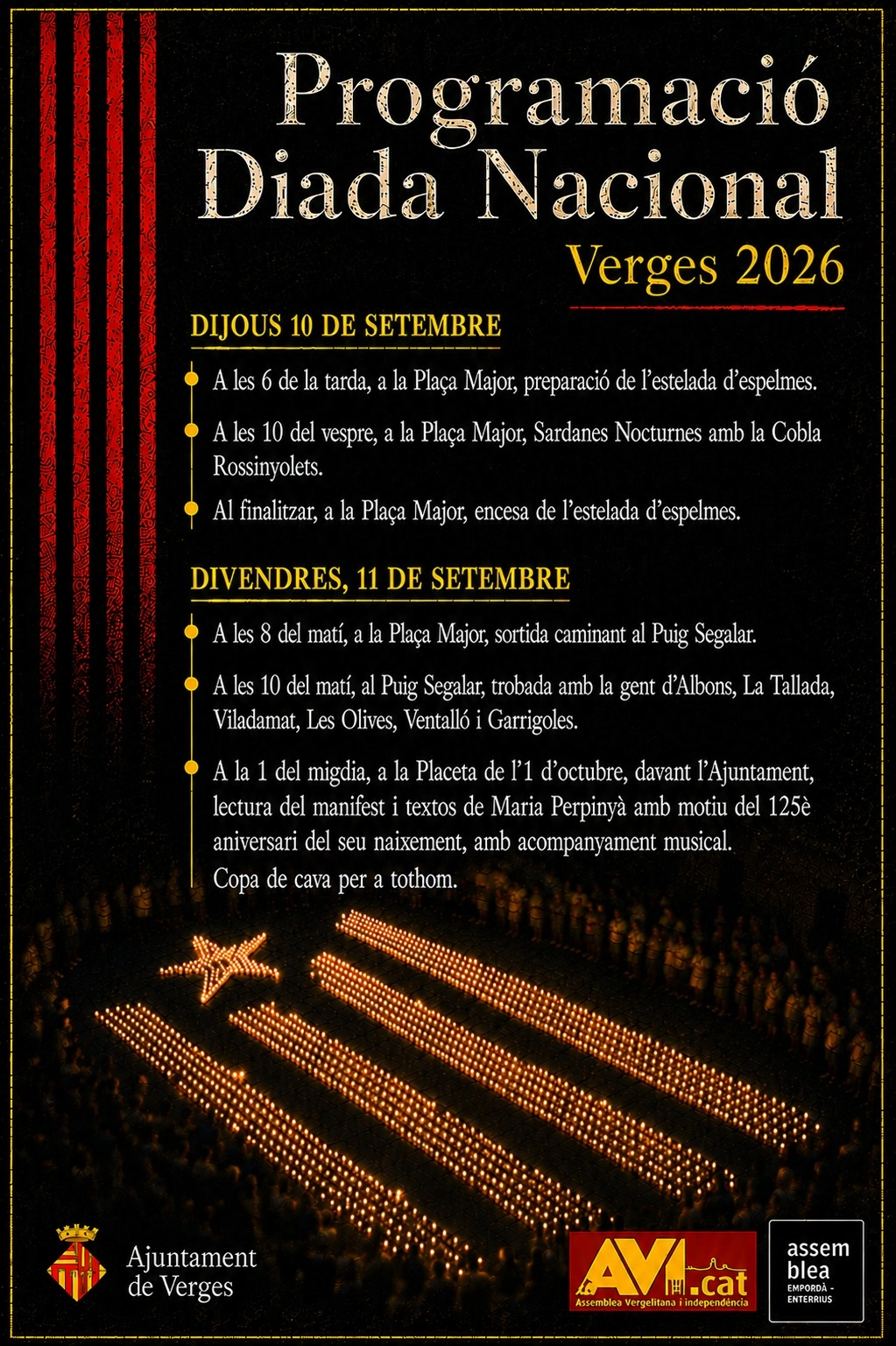
In 2026, Verges is commemorating the 125th anniversary of the birth of Maria Perpinyà i Sais, a writer, poet, journalist and translator who was born in the village on 6 December 1901.
included a special tribute to her life and work
Maria Perpinyà at the 2026 National Day of Catalonia celebrations in Verges
took place on Friday, 11 September 2026
were read with musical accompaniment
For international readers, the Diada Nacional de Catalunya, celebrated every 11 September, is Catalonia’s National Day and one of the most significant dates in the Catalan civic calendar.
In Verges, the 2026 Diada also provided an opportunity
Maria Perpinyà i Sais, a writer born in Verges
Maria Perpinyà i Sais was born in Verges on 6 December 1901 and died in Banyoles on 6 July 1994.
From an early age she showed a strong interest in literature and began sending poems to different Catalan publications. In 1928 she was finally able to move to Barcelona, where she became part of the city’s active literary and intellectual circles.
She worked for the newspaper El Matí and contributed to a wide range of publications, including La Veu de Catalunya, La Paraula Cristiana, La Revista, La Nova Revista, La Nau and D’Ací i d’Allà.
According to research by literary historian Neus Real, by 1934 alone Maria Perpinyà had already contributed more than two hundred pieces to El Matí, including poems, short stories, longer narratives, reviews, articles and Catalan adaptations of literary works, many of them originally written in French.
Her published books included the children’s story collection El follet sentimental in 1930 and the poetry collections Poemes in 1931 and Terra de vent in 1936.
Land, landscape, country and, in particular, the wind are recurring elements in poetry deeply rooted in her native Empordà.
A woman active in Catalan cultural life
Maria Perpinyà belonged to a generation of women who began to gain a more visible role in Catalonia’s cultural and intellectual life during the first decades of the 20th century.
Alongside her work as a writer and journalist, she took part in cultural and social organisations and became involved in initiatives concerning education and the position of women in society.
She was associated with organisations including the Associació Protectora de l’Ensenyança Catalana and joined the board of Acció Femenina, led by writer and journalist Carme Karr.
Her literary and journalistic career was dramatically affected by the Spanish Civil War and the Franco dictatorship. Sources on her life describe how her professional journalism career was brought to an end in a political environment in which the normal public use of Catalan was suppressed.
Although she became increasingly removed from public literary life, Maria Perpinyà never stopped writing, and a substantial part of her work remained unpublished.
Maria Perpinyà and the Verges Procession
Maria Perpinyà also left a direct mark on one of the most important cultural traditions of her home village.
After returning permanently to Verges, in 1955 she revised and updated the texts of the Verges Procession, which had been restructured by her younger brother, Carles Perpinyà.
Her work helped make the language more accessible while preserving the character and identity of the traditional performance.
Her connection with the Procession can also be found in her own poetry.
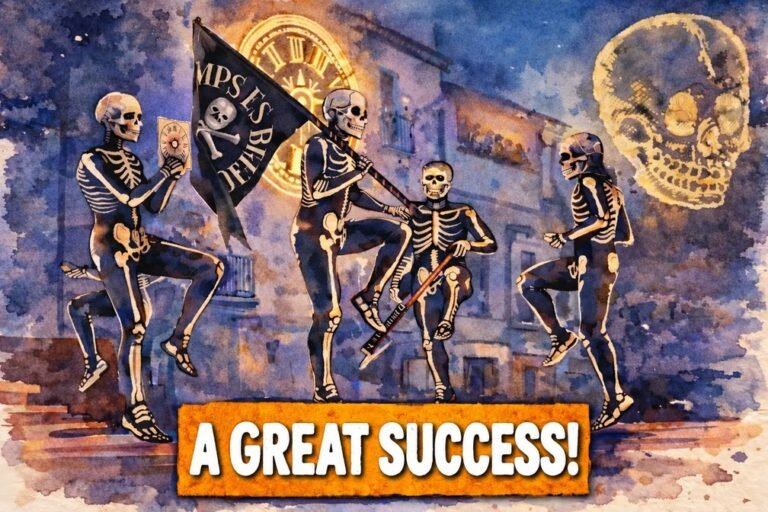
She wrote “Dansa de la Mort a Verges” — “Dance of Death in Verges” — a poem devoted to the famous Dance of Death that forms part of the Holy Thursday Procession.
In 1977, the poem was set to music and its performance was broadcast on television, creating another link between Maria Perpinyà’s literary work and one of Verges’ most distinctive traditions.
Maria Perpinyà therefore belongs not only to the history of Catalan literature, but also to the cultural history of Verges and to the modern development of its Procession.
A legacy that remains visible in Verges
Over the years, Verges has gradually brought renewed attention to Maria Perpinyà and her work.
Since 2012, a public square in the village has carried her name. Maria Perpinyà Square, inaugurated on 8 March 2012, became the first public space in Verges to be named after a woman.
The 125th anniversary of her birth now offers another opportunity to introduce her writing to new generations and to recover the memory of an author whose literary career was once considerably more visible than it became in the decades that followed.
were heard again in Verges
There is something especially meaningful about the way a writer is being remembered: by allowing her own words to speak again.
were read publicly in Verges
In the village where she was born.
The village to which she eventually returned.
And the place whose land, landscape and wind can be felt throughout so much of her writing.
was therefore more than the commemoration
It offered Maria Perpinyà another opportunity
Our small tribute to Maria Perpinyà
For LaProcessodeVerges.com, this anniversary also has a deeply personal meaning.
Maria Perpinyà was my grandmother.
But these pages are not dedicated to her simply because of that family connection.
For twenty-five years, this website has worked to collect, preserve and share the history of the Verges Procession and the people who, in one way or another, have helped shape the cultural heritage of our village.
Maria Perpinyà is part of that history.
Through her literature.
Through her journalism.
Through her commitment to the Catalan language.
Through her bond with Verges.
And through her contribution to the Procession whose history and heritage this website has been documenting and sharing for so many years.
That is why, in the year marking the 125th anniversary of her birth, we wanted to add our own small tribute to her memory.
A tribute from a website created many years after her lifetime, but devoted to preserving part of the very cultural world to which she herself contributed.
At this year’s Diada, Verges gave Maria Perpinyà’s words a voice once again