Holy Week changes date because it is anchored to Easter, and Easter is not fixed to one day in the solar calendar. The Western calculation combines a Sunday, a fixed ecclesiastical spring equinox and a full moon determined from church tables. Once Easter Sunday is known, other movable observances are found by counting backwards or forwards.
The rule in one sentence
In the Western calendar, Easter is the first Sunday after the Paschal full moon that falls on or after 21 March.
Two details prevent common misunderstandings. First, 21 March is the fixed ecclesiastical equinox, although the astronomical equinox can occur on 19, 20 or 21 March. Second, the Paschal full moon is calculated from ecclesiastical tables. It usually lies close to the astronomical full moon but is not decided by observing the sky locally.
A simple example
If the Paschal full moon falls on a Monday after 21 March, Easter is the following Sunday. If it falls on a Sunday, Easter moves to the next Sunday rather than that same day.
Under the Gregorian calculation, Easter can therefore occur from 22 March to 25 April. Every observance tied to it moves within the same five-week range.
Why spring and the moon?
The Gospel accounts place Christ’s death and resurrection in the setting of Jewish Passover, which follows a lunisolar calendar. Early Christians debated how to preserve that relationship while keeping the Resurrection celebration on Sunday.
The Council of Nicaea in 325 is the major historical reference point for a common Sunday celebration. The later computus developed cycles and tables that make it possible to publish Easter dates many years ahead.
Why do Western and Orthodox Easter sometimes differ?
Western churches use the Gregorian calendar for the calculation. Many Orthodox churches continue to use the Julian calendar or Paschal tables based on it. The dates can coincide in some years and separate in others.
It is too simple to say that the churches look at different moons. The main issue is the calendar framework and the ecclesiastical tables used.
Which dates move with Easter?
| Observance | Offset from Easter Sunday |
|---|---|
| Shrove Tuesday | 47 days before |
| Ash Wednesday | 46 days before |
| Palm Sunday | 7 days before |
| Maundy Thursday | 3 days before |
| Good Friday | 2 days before |
| Divine Mercy Sunday | 7 days after |
| Ascension | 39 days after; transferred to Sunday in some places |
| Pentecost | 49 days after |
| Trinity Sunday | 56 days after |
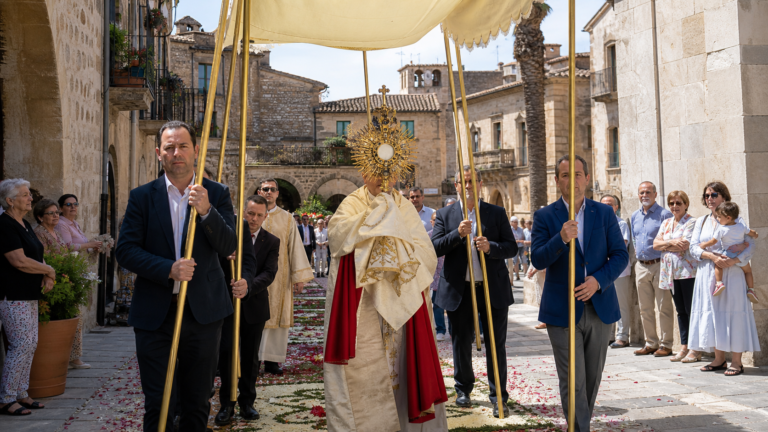
| Corpus Christi | 60 days after; transferred to Sunday in many dioceses |
| Sacred Heart | 68 days after |
| Immaculate Heart of Mary | 69 days after |
Different effects across Europe
The religious calculation is shared across Western churches, but national calendars differ. Ascension Thursday is a public holiday in France and several other countries, while some churches transfer its liturgical observance to Sunday. Corpus Christi is a public holiday in parts of Central and southern Europe but moves to Sunday elsewhere.
Easter Monday, Good Friday and Maundy Thursday also have different civil status from country to country—and sometimes within a country. Europe does not have one uniform set of Easter holidays even when churches share the same Easter Sunday.
Why forty days of Lent when Ash Wednesday is 46 days earlier?
There are 46 calendar days from Ash Wednesday to Easter. The six Sundays are not counted among the traditional penitential days, leaving forty. They still belong to the liturgical season of Lent.
In Verges: Maundy Thursday is always three days before Easter
The Verges Procession in Catalonia takes place on Maundy Thursday night. It needs no separate lunar calculation: once Easter Sunday is known, count back three days.
An early Easter brings forward the rehearsals, Passion play, street procession and Dance of Death. A late Easter moves the whole local programme into April. The date changes because the tradition remains fixed to Maundy Thursday rather than to a numbered day of the month.
One calculation, many consequences
The system has two stages: determine Easter from Sunday, the ecclesiastical equinox and the Paschal full moon; then add or subtract days. Carnival, Lent, Holy Week and a series of later feasts all follow from that single movable date.
Sources
- Catechism of the Catholic Church, 1168-1171.
- USCCB: how the date of Easter is determined.
- Church of England: Tables and Rules for Easter.
- Vatican: Nicaea and the search for a common Easter date.